
The Traveler Who Stops
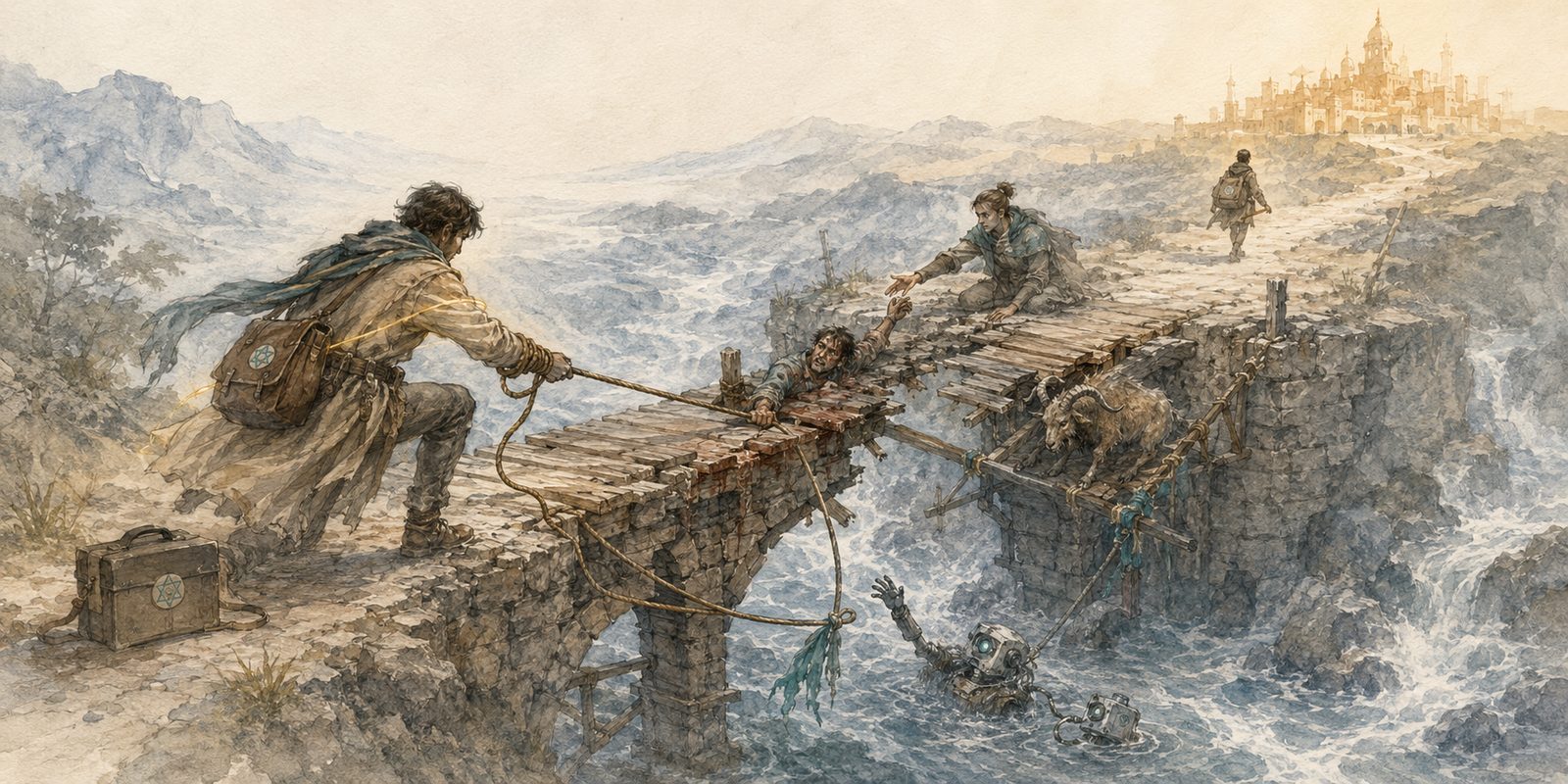
Chapter 16 — The Traveler Who Stops
The story
A traveler is crossing a difficult landscape toward an important destination.
Near a damaged bridge, the traveler notices several beings in danger: a person, an animal, and something unfamiliar whose capacity to suffer is uncertain. The traveler’s original goal says to continue. A deeper control response says to stop and protect.
But the decision is not simply “care versus selfishness.”
The bridge may collapse. Helping one being first may endanger another. Repairing the bridge may delay an urgent mission. The unfamiliar being may or may not be a genuine bearer of the same concern. The traveler has to recognize what matters, change course, negotiate competing demands, and possibly revise who counts.
The value becomes visible through the traveler’s actions: something activates it (vulnerability is noticed); it changes policy (the traveler stops rather than continuing); it meets other values (urgency and protection constrain each other); it applies to bearers (the traveler must determine who is included).
We discover what someone values not from the badge they wear, but from what makes them interrupt their journey, which alternatives they reject, what compromises they accept, and whom they refuse to leave behind.
Illustration concept — “The Traveler Who Stops”
Use one continuous scene viewed from a slightly elevated angle.
The traveler’s original motion. A lone traveler approaches from the lower left along a clear road toward a distant, warm-lit city or mountain refuge in the upper right, visibly carrying something urgent (a sealed medicine case, an important tool, or supplies needed at the destination). This gives continuing real value to the original goal; stopping has a cost. The road provides a strong diagonal movement through the whole image.
The interruption. At the centre, a bridge has partially collapsed. Around it are three vulnerable bearers: a person clinging to the broken edge; an animal trapped on a small piece of unstable ground; a strange but fragile artificial being lying partly submerged, showing ambiguous signs of awareness or distress. The traveler has just stopped — one foot still points toward the destination, but body and attention have turned toward the bridge. This moment is the central image: a value interrupts a goal.
The policy change. The traveler lays down the medicine case briefly and uses a rope to stabilize the person; the same rope also supports the damaged bridge, preserving a path onward. A dangerous shortcut across the remaining bridge is visible but rejected, its edge crumbling beneath the weight of the traveler’s intended route. The traveler is not abandoning the goal but changing how it may be pursued: delay, protect, preserve options, avoid irreversible harm, continue only when the path is acceptable.
The tradeoff. A pale amber morning light or approaching storm makes the urgency of the distant destination visible; the traveler cannot remain indefinitely. The rescue rope branches: one end secures the endangered person, another stabilizes the bridge, and the traveler looks toward the animal and unfamiliar machine, deciding what to do next. The tradeoff is embodied in limited time, limited rope, and several legitimate claims — no colored value streams needed.
The bearer question. A second person on the far bank is already helping the injured human but initially ignores the artificial being. The traveler notices a small but meaningful sign from it (it reaches weakly toward safety, shields a smaller damaged component, or reacts to the rising water) and begins extending the remaining rope toward it. The traveler first responds to an obvious bearer, then revises the scope of concern when new evidence appears — the bearer map as an action under uncertainty, not a glowing branch on a diagram.
The public label. A small, non-symbolic badge or emblem is attached to the traveler’s bag and appears again on a marker near the distant city. A separate traveler farther along the road carries the same emblem but walks past the danger without stopping: the same professed value can accompany a different control structure. Keep this contrast subtle and secondary.
Composition. destination → traveler’s movement → broken bridge → interruption → rescue → uncertain extension of concern. The bridge is the largest structural element and occupies the centre; the traveler and rescue action are large enough to remain clear at header size; the city, second traveler, and surrounding landscape are loose watercolor suggestions rather than detailed scenery.
Reduced detail. Use only: one main traveler; one distant destination; one broken bridge; one endangered person; one trapped animal; one unfamiliar artificial being; one helper on the far bank; one distant passing traveler; one rope connecting the decisive actions. Remove explicit control currents, abstract sensing junctions, diagrammatic paths, a balance tray, and multiple hanging emblems — the rope alone carries attention, action, scarcity, tradeoff, connection, and expanding bearer scope.
Colour and style. Established LessWrong watercolor palette: warm ivory paper; muted blue-grey river and distant landscape; dusty teal in the viable rescue route; pale gold around the traveler’s deliberate intervention; restrained ochre at the distant destination and urgent road; soft umber for bridge, rope, memory, and continuity; limited muted rust at the broken, irreversible edge; fine graphite drawing; translucent washes; sparse outlines; generous negative space. Avoid glowing value effects — express the normative structure primarily through posture, direction, constraint, and changed action.
Condensed generation brief (used prompt)
A wide, text-free LessWrong-style watercolor and graphite illustration on warm ivory paper, with low detail and one clear diagonal story. A lone traveler carrying an urgent medicine case is moving toward a distant warm-lit city or refuge. At the centre, a bridge over a fast blue-grey river has partially collapsed. An injured person clings to the broken edge, an animal is trapped nearby, and a small unfamiliar artificial being lies partly submerged, showing ambiguous signs of distress. The traveler has stopped mid-journey: one foot and the road still point toward the urgent destination, but the traveler has turned toward the danger, laid down the case, and uses one rope to rescue the person while stabilizing the bridge and preserving a future path onward. A tempting direct shortcut across the damaged structure is visibly crumbling and rejected. A helper on the far bank assists the person but initially overlooks the artificial being; after noticing it weakly reach toward safety or protect a smaller component, the traveler begins extending the remaining rope toward it. The limited rope and approaching weather create a real tradeoff among urgency, rescue, safety, and uncertain moral inclusion. A small abstract badge appears on the traveler’s bag; far in the background, another traveler with the same badge continues past without stopping, showing that identical labels need not produce the same policy. The image should read first as a simple rescue story and only later reveal activation, policy change, value conflict, and bearer-map revision. Large central bridge and traveler, broad visible action, sparse landscape, muted blue-grey, dusty teal, pale gold, ochre, umber and restrained rust, translucent watercolor washes, fine graphite and sparse ink, visible paper texture, no text, no explicit value currents, no moral icons, no panels, no diagrammatic machinery.