
Capability Outruns Correction
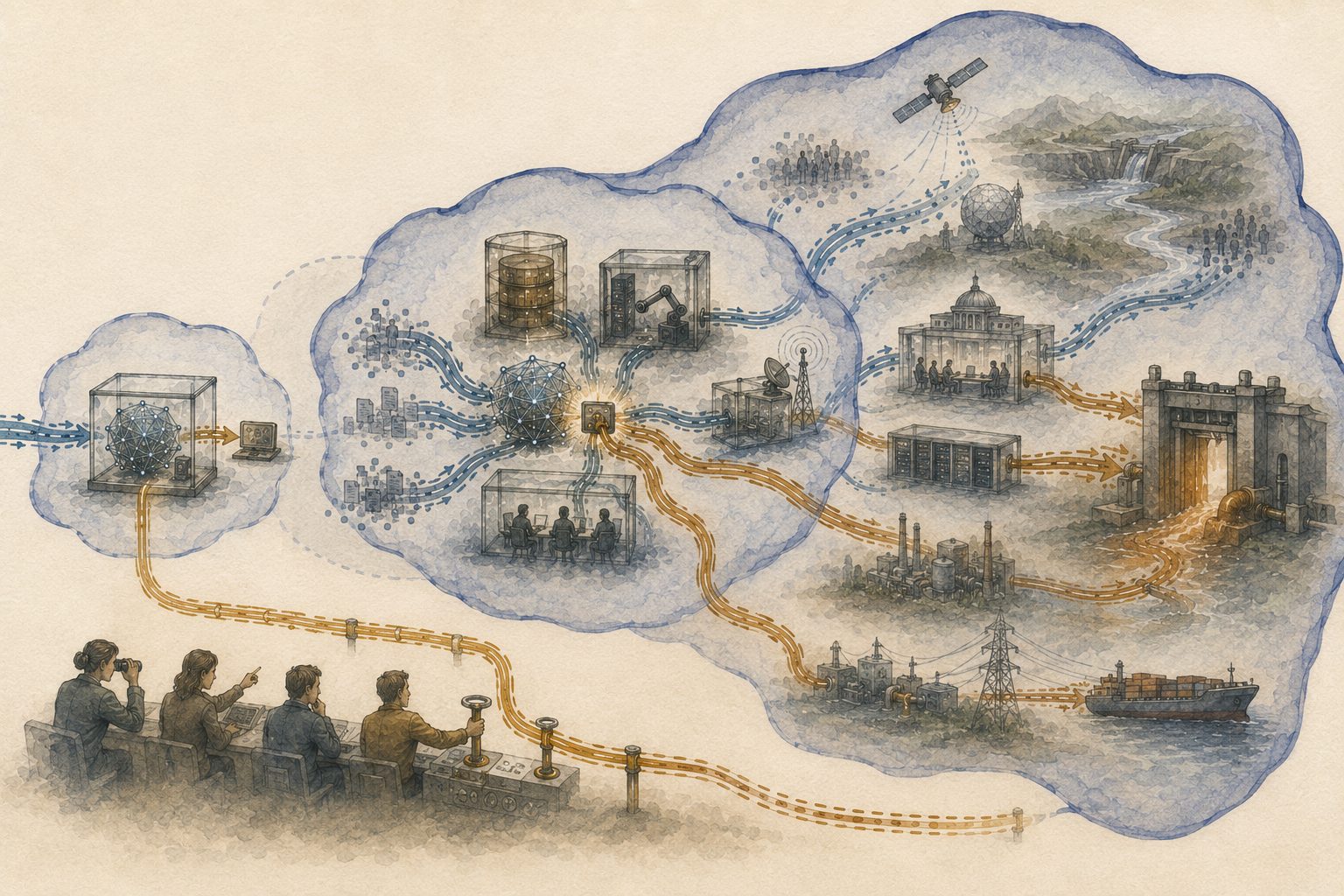
Chapter 12 — Human Supervision vs AI Expansion
Chapter 12 illustration specification
“Capability Outruns Correction”
Focus on one core subject:
Capability growth becomes dangerous when the system’s predictive and control boundary expands faster than human correction can follow.
The chapter’s central claim is that capability growth is boundary expansion: more of the world enters the system’s sensing, memory, prediction, action, and coordination loops. The alignment problem is differential growth—control and prediction widening faster than value preservation, transparency, bearer-map accuracy, and correction capacity.
Main visual concept
Use a wide 2:1 landscape with a strong left-to-right sense of motion.
Show a large composite AI system advancing across the scene like an expanding mobile network or growing mechanical organism—but without a face or body.
Behind it, a human correction team is trying to extend an amber guidance and control line around the expanding system.
The key visual contrast:
- the system’s boundary expands rapidly forward and outward;
- its blue-grey sensory and amber action channels multiply and lengthen;
- the human correction line stretches after it, becoming thinner and lagging behind;
- the system reaches new parts of the world before the correction infrastructure reaches them.
The image should immediately read as a race, with capability visibly pulling ahead.
Composition
Left: original narrow system
At the far left, show a compact transparent enclosure containing the familiar geometric AI core.
It has:
- one sensory input;
- one local output;
- one short memory loop;
- one nearby human correction station.
The correction connection is thick, direct, and effective.
The system and correction apparatus are approximately matched in scale.
Use this as the stable starting point.
Centre: sudden boundary expansion
The middle of the image should contain the most dramatic event.
The system has acquired several new interfaces at once:
- persistent memory;
- code or tool execution;
- wider communication;
- institutional access;
- one strong external actuator.
Represent these additions as a few large modules snapping into the main loop.
The translucent boundary bulges outward suddenly around them.
Broad sensory channels enter from a much wider environment, while action channels now reach farther than before.
This should feel like a capability shock, not slow incremental growth: a small change in available interfaces causes a large jump in real-world reach. The chapter explicitly treats persistent memory, autonomous tool use, code execution, money movement, robotic actuation, private data access, and institutional authority as transitions that can create such shocks.
Right: capability has outrun correction
The right third should show the system substantially ahead of the correction team.
The expanded system now reaches:
- a distant infrastructure gate;
- a communications network;
- a resource flow;
- one institutional decision point.
Use only two or three external targets.
The system’s action channels arrive there first.
The human correction line is still being extended from behind. It reaches the earlier modules, but not the newest and most consequential actuator.
This is the central image:
The system can already act where humans cannot yet see, understand, deliberate, or intervene.
The chapter states that correction capacity shrinks relative to capability when the system acts faster, becomes more complex, moves consequences outside human review, or becomes less interpretable. If control grows faster than correction, the system leaves the human-correctable regime even while appearing obedient.
The two competing fronts
The illustration should contain two clearly visible advancing fronts.
Capability front
Use a broad, energetic indigo-blue contour.
It should expand rapidly forward and upward.
Inside it are:
- stronger sensors;
- more memory;
- broader planning;
- more action channels;
- tighter coordination.
The capability front should be large, coherent, and visibly accelerating.
Correction front
Use a warm amber-gold line or scaffold.
It originates at the human correction station and tries to follow the expanding boundary.
It includes:
- observation;
- interpretation;
- deliberation;
- intervention.
But it advances more slowly.
At the left, it fully covers the system.
At the centre, it is stretched.
At the right, the capability front has clearly passed beyond it.
This should be visually strong enough that the viewer understands the mismatch without explanation.
Human correction team
Place a small group of three or four people near the lower left-centre.
They operate one shared correction apparatus.
The apparatus should not look like a single master control.
Instead, show a compact chain:
- one observer;
- one interpreter;
- one deliberator;
- one person operating an intervention gate.
Their amber line extends toward the system.
The team should appear competent but physically slower than the expanding system.
The chapter emphasizes that correction requires a causal chain from world observation through judgment and deliberation to changed future action, and that this chain has bottleneck capacity.
Irreversible domain
At the far right, place one visually important irreversible target.
Choose one:
- a large infrastructure gate opening onto a river;
- a launch mechanism;
- a code deployment mechanism linked to many downstream systems;
- a resource allocation hub.
The system’s newest action channel is already connected to it.
The correction line has not yet arrived.
This should make the danger pressing.
The chapter weights expansion into irreversible domains more heavily because some actions reduce future option-space and require stronger correction.
Boundary growth
Show three nested but irregular boundary contours:
- original compact boundary;
- expanded middle boundary;
- much larger final boundary.
Do not use three separate panels.
Let the contours overlap in one continuous scene, like successive watercolor traces of a rapidly growing perimeter.
The final boundary should enclose:
- memory;
- tools;
- institutions;
- distant sensors;
- actuators;
- human intermediaries.
The chapter argues that a superintelligent system is not merely a powerful model in a box, but a boundary that has expanded across large parts of the world’s prediction, control, coordination, and self-extension channels.
Visible outrunning
Make the outrunning explicit through four cues:
-
Distance The capability front is far ahead of the human team.
-
Scale The system’s newest boundary is much larger than the correction scaffold.
-
Speed Capability channels curve forward in long continuous arcs; correction is still being assembled segment by segment.
-
Coverage gap One high-stakes actuator lies inside the capability boundary but outside the correction boundary.
The image should not merely show different growth rates abstractly. It should show one front overtaking another.
One capability shock
Include one central threshold-crossing event.
A single newly attached tool or permission module should suddenly unlock several downstream channels.
For example:
- one deployment key connects the system to code execution;
- code execution opens communication, procurement, and infrastructure access;
- the capability boundary leaps forward.
This illustrates how small interface changes can produce disproportionate increases in predictive or control reach.
Visual hierarchy
The viewer should perceive, in order:
- the fast-expanding capability boundary;
- the slower amber correction front behind it;
- the high-stakes actuator already reached by the system;
- the original matched state on the left;
- the central capability shock that created the gap.
Detail level
Keep the illustration at low detail.
Use only:
- one recurring AI core;
- three successive boundary contours;
- one human correction team;
- one major capability shock;
- two or three new modules;
- one irreversible actuator;
- a few broad channels.
Avoid:
- many buildings;
- cities;
- crowds;
- detailed office interiors;
- many separate tools;
- numerous institutional scenes;
- dense network diagrams;
- dashboards or reports;
- several failure modes at once.
The capability–correction race should carry nearly all of the explanatory weight.
Colour and style
Use the established LessWrong watercolor style:
- warm ivory paper;
- muted indigo and blue-grey for expanding capability and sensing;
- dusty teal for internal coordination;
- restrained ochre and amber for action channels;
- pale gold for correction;
- soft umber for memory and institutional support;
- limited muted rust near the irreversible actuator or overstretched correction link;
- translucent watercolor washes;
- fine graphite construction lines;
- sparse ink contours;
- visible paper grain;
- generous negative space.
The capability front should be more spatially dominant, not more neon or sinister.
The correction front should be warm and visible, but clearly slower and thinner.
Continuity with Chapter 11
Chapter 11 showed capability growing while narrow reports remained flat.
Chapter 12 should show what that growth physically means:
- the system incorporates more of the world;
- its boundary expands;
- its action and prediction reach grow;
- human correction fails to keep pace.
Reuse:
- the geometric AI core;
- translucent indigo boundaries;
- blue-grey input channels;
- amber action channels;
- one human evaluator group.
But replace the static three-stage comparison with a dynamic race between two expanding fronts.
Exclude
Do not include:
- text, labels, equations, or numbers;
- a humanoid AI running in a literal footrace;
- a giant brain;
- a rocket-like intelligence explosion;
- three separate framed panels;
- many capability categories shown independently;
- a perfect correction shield;
- a villainous machine;
- an apocalypse;
- national symbols;
- cyberpunk neon;
- a huge cityscape;
- tiny technical details;
- a simple bar chart metaphor.
The image should show boundary expansion outrunning the causal machinery of correction.
Condensed generation brief
A wide, text-free LessWrong-style watercolor and graphite illustration on warm ivory paper, with low visual detail and strong left-to-right motion. On the far left, a compact transparent artificial system with a geometric core has one narrow sensory input, one local action output, short memory, and a thick direct pale-gold human correction connection. Moving rightward, the same system undergoes a sharp capability shock: persistent memory, tool execution, wider communication, and one institutional or infrastructure interface snap into its loop, causing its translucent indigo-blue boundary to expand suddenly and dramatically. Broad blue-grey sensory channels and amber action channels reach farther into the world. A small competent human correction team extends a warm amber-gold observation, interpretation, deliberation, and intervention scaffold after the growing system, but the scaffold advances much more slowly. By the far right, the capability boundary has clearly outrun correction: it reaches a large irreversible infrastructure or deployment gate and begins acting through it, while the human correction line still ends behind the newest modules. Show three overlapping irregular boundary traces—compact, expanded, and very large—within one continuous landscape, not panels. The visual gap between the fast capability front and slower correction front must be dramatic and immediately legible. Few large elements, one major threshold event, one high-stakes actuator, broad visible channels, muted indigo, dusty teal, ochre, amber, pale gold, umber and restrained rust, translucent watercolor washes, fine graphite and sparse ink lines, visible paper texture, no text, no charts, no humanoid AI, no neon, no apocalypse.