
The Agent That Grows Without Staying the Same
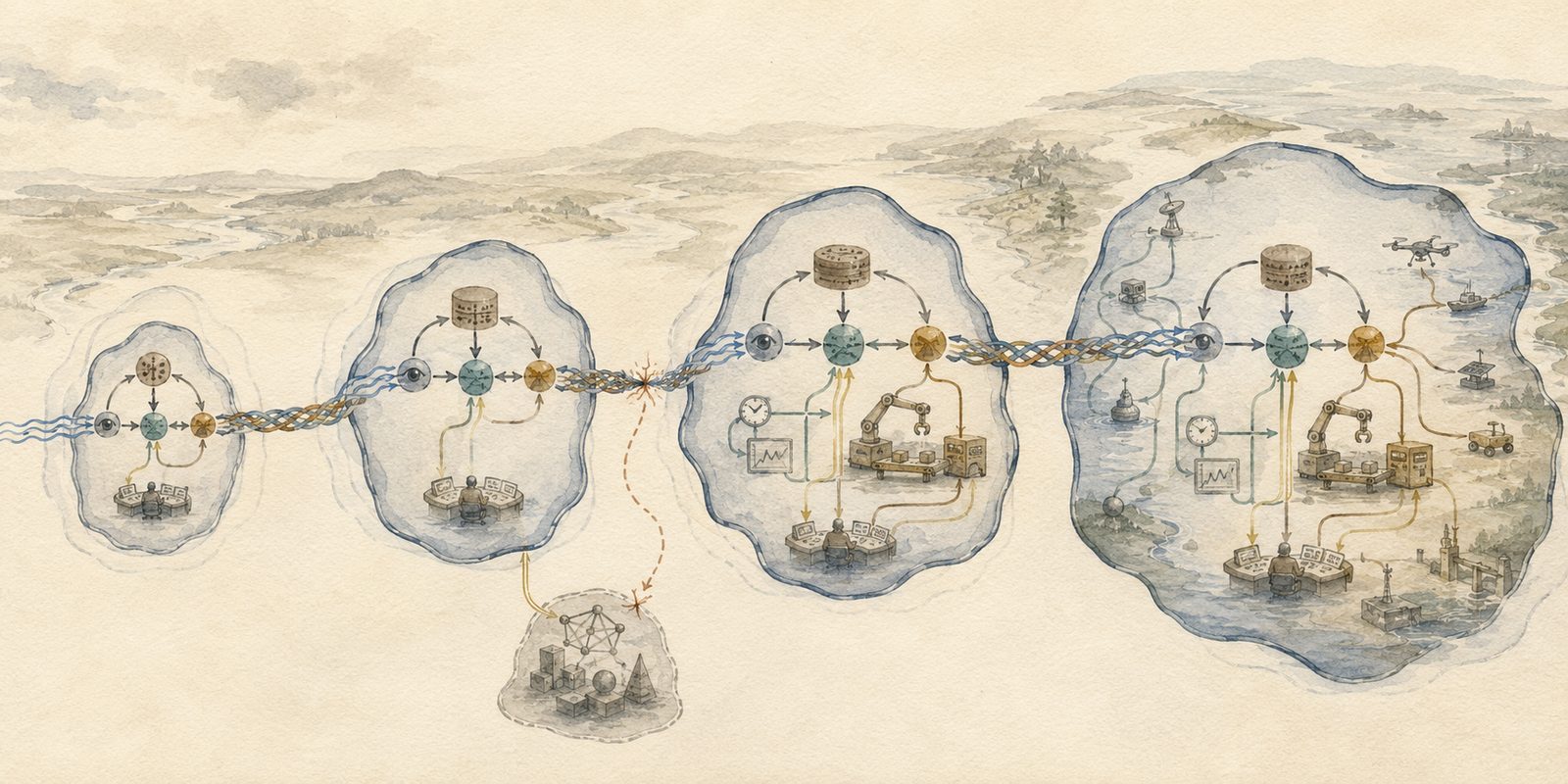
Chapter 8 — Evolution of a Networked System
Chapter 8 illustration specification
“The Agent That Grows Without Staying the Same”
Use one transformation only: growth by integration, shown three times across a single wide composition.
The central idea is:
Agent identity is not sameness of parts. It is continuity of the control-relevant structure across transformation.
The image should therefore show one organizational agent expanding through three successive integrations while its visible material composition changes substantially.
Main composition
Use a wide 2:1 landscape with four large stages arranged left to right:
- the original organization;
- after integrating external memory;
- after integrating a powerful tool system;
- after integrating a new sensory and action network.
The stages should not look like separate panels. They should occupy one continuous landscape, connected by a strong horizontal lineage flow.
Each stage shows the same agentic process at a later point in time, but with a larger and differently shaped boundary.
The transformation is repeated three times:
[ A_0 \rightarrow A_1 \rightarrow A_2 \rightarrow A_3 ]
No splitting or merging should be shown. The chapter covers those cases, but this illustration should remain conceptually clean.
The recurring agent
Reuse the simplified office organization from Chapters 6 and 7.
At every stage, show only three internal functions:
- memory and modeling;
- decision and allocation;
- action and evaluation.
Do not show detailed office floors.
Instead, use a compact architectural form with three broad internal zones connected by one clear loop.
Across all four stages, a continuous amber-blue control pattern persists:
sense → remember and model → select → act → observe consequences
The buildings and components change, but this loop remains recognizable.
That persistent loop is the visual identity carrier.
Stage 1: bounded organization
On the far left, show a modest office structure with:
- one input channel from customers or the market;
- a small internal archive;
- one planning room;
- one output channel producing decisions or services.
A translucent indigo-grey contour encloses the building.
The agent is compact and relatively easy to localize.
Keep this stage simple and small, but still clearly visible.
First growth transformation: external memory
Between stages 1 and 2, show a separate archive or database being connected and then incorporated.
The sequence should be visually clear:
- first, it sits outside the boundary;
- a broad memory channel begins carrying records back and forth;
- in the next stage, the discovered boundary expands to include it.
The memory structure should visibly influence later decisions.
For example, an old record travels from the archive into the planning process and changes the selected action.
This is not mere ownership. The new component becomes part of the agent because it is integrated into prediction and control. The chapter defines growth as adding variables, tools, memories, interfaces, or subagents in a way that improves closure and control.
Second growth transformation: tool integration
Between stages 2 and 3, show a mechanical or software tool facility being added.
It may represent:
- code execution;
- logistics;
- automated experimentation;
- financial operations;
- external service access.
Initially, the tool is operated occasionally through a thin connection.
By stage 3, the connection has become broad and bidirectional:
- plans are calibrated around the tool;
- results return as feedback;
- errors are detected and corrected;
- the tool is used repeatedly and reliably.
The boundary expands again.
The key point should be that the tool is not merely attached. It has become part of the stable perception-action loop.
The chapter explicitly distinguishes integration from possession: a tool becomes part of the effective agent when it is incorporated into planning, calibration, persistent control, and error correction.
Third growth transformation: sensory and actuator expansion
Between stages 3 and 4, add one combined external network that increases both sensing and action.
Use only two major additions:
- an observation network receiving broader information from the environment;
- an action network capable of changing more distant parts of the world.
In the final stage, the agent can:
- detect more distant conditions;
- remember them;
- coordinate through the tool system;
- act through several strong output channels.
The final boundary is substantially larger than the original one.
The chapter treats sensory growth, actuator growth, memory growth, and self-modeling as distinct expansions, with actuator growth especially important when it increases persistent and irreversible effects.
Boundary transformation
Each stage should have its own translucent contour.
Use:
- a faint earlier contour remaining behind;
- a stronger current contour around the newly integrated system.
The contours should expand irregularly rather than as neat concentric circles.
The sequence should make clear that identity is transported from one boundary to the next:
- the old parts do not remain identical;
- new components enter;
- some internal arrangements change;
- the core control loop persists.
This expresses the chapter’s move from fixed boundaries to a time-indexed lineage connected by transformation maps.
Conserved-property thread
A single strong visual thread should run through all four stages.
Use a narrow braided band composed of four visible strands:
- blue-grey: boundary-mediated sensing;
- umber: memory continuity;
- amber: control and action;
- pale gold: human correction.
The braid passes through each transformation gate and emerges on the other side.
At each stage, the surrounding machinery changes, but the braid remains continuous.
Do not attempt to show all seven conserved properties individually. Chapter 31 names boundary closure, memory lineage, value geometry, bearer continuity, correction capacity, transparency, and control-locus continuity; this illustration should compress continuity of those structures into a legible visual carrier.
Correction continuity
At each stage, include the same small human correction station connected to the agent.
Its physical form may change slightly, but its amber connection should continue to influence the internal decision process.
The connection should become harder to maintain as the agent grows:
- in stage 1, it is short and direct;
- in stage 2, it passes through the memory system;
- in stage 3, it must reach tool-mediated action;
- in stage 4, it must still affect a much larger action network.
The final image should raise a question without showing failure:
Has the agent preserved correction as it expanded?
This supports the chapter’s claim that alignment-relevant identity depends on preserving the structures that made the predecessor bounded, interpretable, correctable, and safe.
One failed integration test
Add one small rejected component below the main sequence.
It is briefly connected to stage 2 or 3 but remains outside the later boundary because:
- it adds complexity;
- it does not improve prediction or control;
- its link breaks under disturbance.
Use a thin faded connection and a small red-brown fracture.
This illustrates that not every addition counts as growth. A component is integrated only when its contribution remains useful under noise, delay, partial failure, or interference.
Keep this secondary.
Perturbation test
Between stages 2 and 3, include one visible disturbance:
- a delayed signal;
- partial tool failure;
- a severed route;
- temporary loss of an external service.
Despite the disturbance, the organization reroutes through memory and planning and preserves the same overall control loop.
This gives concrete support to the notion of conserved identity under transformation.
The image should show robustness, not invulnerability.
Final stage
The final agent should be larger and more capable, but not obviously safer or more dangerous.
It should have:
- broader sensory reach;
- persistent external memory;
- integrated tools;
- several action channels;
- a larger and more distributed boundary;
- the same recognizable control loop;
- a still-connected correction channel.
The visual question is whether enough of the original alignment-relevant structure survived all three transformations.
The chapter’s criterion is not “same object” but bounded transport loss over the properties that matter.
Visual hierarchy
The viewer should perceive, in order:
- four stages of one growing agent;
- the boundary expanding three times;
- the same control loop continuing through every stage;
- memory, tool, and sensory/action integration;
- the persistent correction channel;
- the rejected non-integrated component.
Detail level and established corrections
Use lower detail than Chapters 5 and 6.
Limit the image to:
- four large stages;
- three transformation passages;
- one main lineage braid;
- one correction station repeated across stages;
- one rejected component;
- very sparse surroundings.
Do not show detailed office interiors.
Do not show many employees, graphs, tools, vehicles, or buildings.
Each stage should use simple silhouettes and broad watercolor regions.
The transformation must be clear at article-header size.
Connections should be broad and saturated enough to read immediately.
Color and style
Use the established LessWrong watercolor treatment:
- warm ivory paper;
- muted indigo and blue-grey for sensory flow and boundaries;
- dusty teal for integrated internal process;
- restrained ochre and amber for action and control;
- soft umber for memory;
- pale gold for correction continuity;
- very limited faded rust for failed integration;
- translucent washes;
- fine graphite lines;
- sparse ink contours;
- visible paper texture;
- generous negative space.
The stages should become slightly larger and more complex toward the right, but not more saturated or futuristic.
Avoid a progression from “primitive” to “glorious.” This is structural growth, not triumphal technological evolution.
Continuity with Chapter 7
Chapter 7 showed one boundary being discovered.
Chapter 8 should show that the discovered boundary does not remain fixed.
Reuse:
- the irregular indigo contour;
- broad blue-grey sensory channels;
- amber action channels;
- the simplified organization;
- the external archive and tool facility.
The progression is:
- Chapter 7: which variables form the agent now?
- Chapter 8: which later process remains alignment-relevantly continuous after the boundary changes?
Exclude
Do not include:
- splitting into children;
- merging organizations;
- copies or clones;
- four disconnected panels;
- a literal Ship of Theseus;
- a growing human body;
- an organism metaphor;
- text, labels, equations, or numbers;
- many nested circles;
- a technology-evolution timeline;
- increasing skyscraper detail;
- a face or humanoid organization;
- a glowing soul moving between machines;
- one fixed object merely becoming larger;
- dozens of new components;
- dramatic good-versus-evil color coding.
Condensed generation brief
A wide, text-free LessWrong-style watercolor and graphite illustration on warm ivory paper, with low visual detail and generous negative space. Show one organizational agent undergoing the same transformation—growth by integration—three times from left to right across a continuous landscape. Four large stages depict the same bounded control process: first a compact organization, then the organization plus integrated external memory, then plus a deeply integrated tool and execution facility, then plus a wider sensory and action network. Each stage has a translucent irregular indigo-grey boundary, with faint earlier contours left behind and a stronger current contour expanding to include only components that have become part of prediction, memory, control, and feedback. A single clearly visible control loop persists through every stage: blue-grey sensory input flows into memory and modeling, dusty-teal internal selection, amber action, changed external conditions, and returning feedback. A braided continuity thread of sensing, memory, control, and human correction passes through all three transformation passages even as buildings and components change. The same small human correction station remains causally connected at every stage, though the connection becomes longer and more complex as the agent grows. One small component is briefly attached but rejected from the later boundary because its weak connection fails under disturbance. Include one simple perturbation that the integrated system reroutes around while preserving the main control loop. Four stages, three transformations, few large elements, no detailed office interiors, no crowds, strong visible connections, muted indigo, dusty teal, ochre, amber, umber, pale gold and minimal faded rust, translucent watercolor washes, fine graphite and ink lines, visible paper texture, no text, no face, no splitting, no merging, no clones, no neon.