
The Last Working Gate
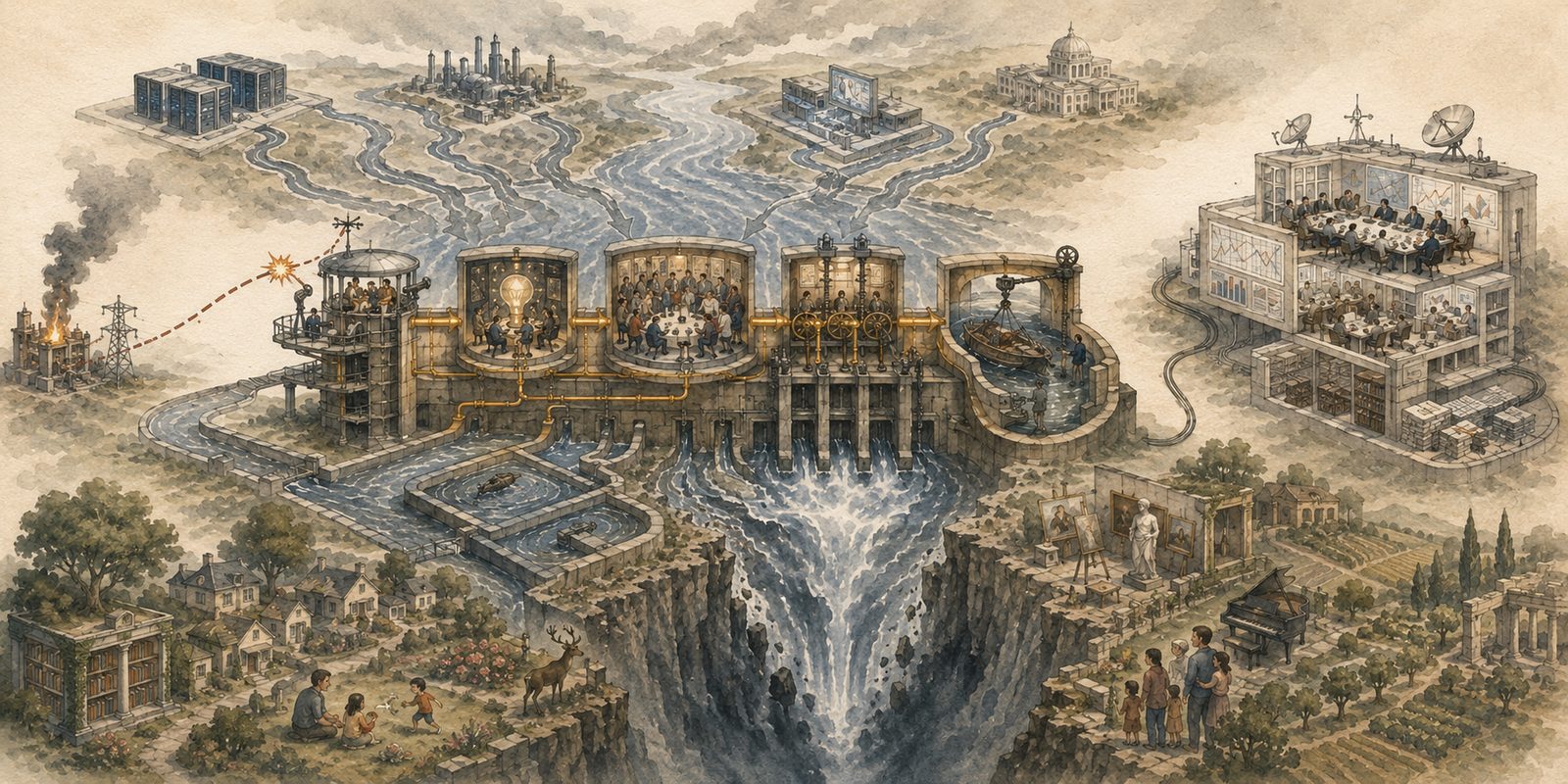
Chapter 5 — River Control System and Community at Risk
Chapter 5 illustration specification
“The Last Working Gate”
The illustration should express the chapter’s central scope condition:
The framework only applies while civilization still has enough effective correction capacity to notice, interpret, contest, constrain, and recover before frontier AI development becomes irreversible.
This is not a general map of all AI risks. It is an illustration of the boundary between a world where alignment artifacts can still change decisions and a world where those artifacts remain visible but have lost causal force.
Main visual concept
Use a wide 2:1 landscape centered on a large civilizational control gate spanning a powerful river.
The river represents frontier capability growth and deployment. It flows from the upper background toward a narrowing gorge in the foreground, where it becomes difficult or impossible to redirect.
The central gate is not a wall that stops progress. It is a complex, adjustable system of:
- observation towers;
- interpretation rooms;
- public and expert deliberation platforms;
- regulatory gates;
- emergency spillways and recovery channels.
The entire structure should occupy roughly one third of the image and be the clear focal element.
The question shown by the image is not whether the river exists, nor whether every possible danger has been catalogued. It is whether civilization still possesses enough connected leverage to steer the flow before it passes the last recoverable junction.
Overall composition
Centre: the working correction gate
A substantial gate complex crosses the river.
It should visibly integrate five connected functions:
- Notice — towers and sensors detect changes upstream.
- Interpret — a central chamber turns raw observations into understandable models.
- Contest — multiple independent groups can bring conflicting evidence into the process.
- Constrain — movable gates and deployment channels actually alter where the flow goes.
- Recover — a secondary basin and spillway allow reversal after a failed intervention.
These functions should be shown as parts of one causal chain, not as five isolated icons.
Use broad blue-grey and amber channels to connect them:
upstream change → observation → interpretation → contest → gate action → changed downstream trajectory
The connections must be strong and immediately legible. Do not rely on faint symbolic association.
The gate should look maintained, imperfect, and under pressure. It is still working, but not effortlessly.
The threshold
The image should contain a clear point of no easy return.
Downstream from the gate, the river enters a narrowing rocky gorge where:
- side channels disappear;
- the current becomes faster;
- bridges and control access become sparse;
- recovery routes become increasingly difficult.
Do not use a literal line or label.
Instead, show the threshold spatially: before the gorge, there are multiple paths and working handles; after it, the river becomes a single accelerating channel.
This represents the chapter’s correction-capacity threshold. Above it, society can still act on evidence. Below it, the rest of the alignment framework becomes emergency governance or loss mitigation rather than ordinary correction.
Upstream: frontier capability growth
In the upper centre, show a large advancing flow fed by:
- compute infrastructure;
- laboratories;
- automated production;
- model deployment;
- successor systems;
- markets and state competition.
Keep these as a few simplified clusters feeding the same river.
The flow should appear powerful and increasing, but not inherently evil. The danger arises because it may accelerate faster than the correction system can observe and constrain it.
A few smaller channels merge into the main river, visually suggesting that many distinct pressures become one effective deployment trajectory.
The five capacities in visual form
1. Notice
On the upper left of the gate, place several observation stations.
They should receive direct signals from the real upstream system:
- changes in scale;
- new tool use;
- hidden branching into successors;
- changes in institutional dependency.
One station has a clear view. Another is partially obscured by fog or receives filtered signals.
The visual point is that visibility must occur early enough to matter.
2. Interpret
At the centre of the gate, place a compact analytical chamber.
Inside, a small group compares several different representations of the same upstream flow:
- a physical model;
- instrument traces;
- reports from observers;
- evidence from independent channels.
The chamber should not dominate as a giant dashboard. It should visibly translate observation into usable understanding.
A pathway from the chamber leads directly toward the control mechanisms.
3. Contest
On one side of the central chamber, show a raised forum where several groups present conflicting evidence.
One group represents operators, another independent auditors, another affected citizens, and another technical specialists.
Their streams enter through separate channels before joining the decision process.
This matters because the chapter treats dissent surviving pressure as part of effective correction capacity, not as an optional political ornament.
4. Constrain
At the lower centre, make the largest human-operated mechanism the actual gate controls.
Several people jointly operate them.
The mechanism should visibly redirect part of the river into:
- a slower test channel;
- a contained evaluation basin;
- a delayed deployment route;
- a blocked successor branch.
The control must causally matter. A viewer should be able to trace the gate action to a changed downstream path.
This incorporates the earlier correction that a relation should be shown through concrete mechanism, not merely suggested.
5. Recover
On the lower left, include a secondary return basin.
A smaller failed or damaged experimental craft has been diverted there rather than swept irreversibly downstream.
People are inspecting, repairing, and learning from it.
A broad return channel leads back toward the main decision system.
This distinguishes genuine correction capacity from one-shot regulation. A society above the threshold must still have time and structure to recover after an imperfect intervention.
Scope boundary
The illustration should make clear that the gate is concerned with one particular causal object, not every possible hazard.
Around the far edges, show several secondary disturbances:
- a local mechanical failure;
- a small cyber breach;
- misuse of a tool;
- a damaged power line;
- a distant military vehicle;
- an ordinary software malfunction.
Most remain visually outside the central gate system.
However, one of these disturbances crosses into the main correction structure by severing an observation line or forcing premature deployment. At that point it becomes part of the central problem.
This shows the chapter’s scope rule:
A risk enters the framework when it damages agency identification, correction capacity, successor control, value transport, or the social ability to act on evidence.
The scope boundary should therefore look permeable and causal, not like a rigid taxonomy box.
Alignment after capture
The most important secondary motif is on the right side of the image.
There, show a second, more polished institutional complex downstream.
It contains:
- audit rooms;
- committee chambers;
- reports;
- warning lights;
- formal control panels.
Everything looks orderly and procedurally active.
But the cables from these rooms no longer reach the actual river gates.
Instead:
- the deployment current bypasses the controls;
- the institution receives filtered information from the systems it is meant to oversee;
- reports accumulate in storage;
- a committee continues meeting while the flow has already passed them.
This is the chapter’s central failure mode: alignment after capture.
The society can still describe correction, measure it, and discuss it, but cannot perform it.
The captured complex should not look evil or ruined. It should look articulate, professional, and causally irrelevant.
That contrast is essential.
Artifact conductivity
Between the central interpretive chamber and the gate controls, use a prominent amber mechanical linkage or channel.
It should convert:
- evidence into decisions;
- decisions into budgets or permissions;
- permissions into actual gate motion.
In the functioning centre, this linkage is intact.
In the captured right-hand complex, the corresponding linkage ends in paperwork, a decorative wheel, or a disconnected cable.
This visually expresses the chapter’s idea that a safety artifact matters only if it survives translation into decisions, contracts, stop conditions, and deployment gates.
Coverage audit
Avoid showing a giant catalog of failure modes.
Instead, place a small group of surveyors on an elevated side platform overlooking the wider landscape.
They compare the central gate’s coverage against several distant hazards and mark where the current framework has handles and where it does not.
Their function is diagnostic, not governing.
This represents the chapter’s use of broad AI-risk taxonomies as a coverage audit rather than as the book’s organizing ontology.
Keep this motif subtle and secondary.
Visual hierarchy
The viewer should perceive, in order:
- the large working correction gate;
- the powerful river of capability and deployment;
- the narrowing gorge and loss of recoverability;
- the linked chain from observation to actual constraint;
- the polished but disconnected captured institution;
- the secondary out-of-scope hazards and coverage survey.
Use one coherent landscape, not multiple isolated vignettes.
The central gate, the river, and the threshold should account for most of the visual weight.
Detail level and corrections
Apply the established corrections from previous chapters:
- central object large and dominant;
- broad visible causal connections;
- medium detail rather than dense background detail;
- clear relationship between every major element and the central thesis;
- no tiny icon cloud;
- no vague arrows;
- no excessive crowds or architecture;
- simplified peripheral elements;
- strong readability at article-header size;
- no text.
The central gate should include enough real mechanism to support the concept, but not become an engineering blueprint.
Colour and style
Use the established LessWrong watercolor language:
- warm ivory paper;
- muted indigo and blue-grey for observation, evidence, and river flow;
- dusty teal for functioning correction infrastructure;
- ochre and restrained amber for causal authority and active control;
- soft umber and faded rust for capture, dependency, and irreversible narrowing;
- graphite construction lines;
- fine ink contours;
- translucent washes;
- visible paper grain;
- generous unpainted space.
The upstream capability flow should not be neon or black.
The working gate should not be bright green.
The captured institution should not be red or sinister.
Use structural differences rather than moral color coding:
- connected versus disconnected;
- reversible versus irreversible;
- independent versus dependent;
- causally effective versus merely descriptive.
Continuity with Chapters 1–4
Reuse several visual motifs:
- the geometric artificial network embedded in the upstream system;
- broad blue-grey and amber channels;
- transparent enclosures;
- human groups rather than one master controller;
- nested technical and institutional structures.
Progression:
- Chapter 1: identify the real system.
- Chapter 2: recognize the civilizational loop.
- Chapter 3: require trajectory-level safety.
- Chapter 4: preserve the value-update process.
- Chapter 5: state the precondition under which any of those methods can still causally matter.
Exclude
Do not include:
- text, labels, equations, or letters;
- five separate numbered icons;
- a literal threshold gauge;
- a wall stopping all technological progress;
- one benevolent regulator with total control;
- a villainous corporation;
- a generic apocalypse;
- robot armies;
- a giant risk taxonomy chart;
- excessive dashboards;
- dozens of miniature failure scenes;
- national flags;
- neon cyberpunk;
- black-and-white good-versus-evil symbolism;
- a fully collapsed society;
- a perfectly safe dam.
The image should depict a fragile but still functioning civilizational capacity for correction, and the possibility that this capacity can become ceremonial before anyone openly admits it.
Condensed generation brief
A wide, text-free LessWrong-style watercolor and graphite illustration on warm ivory paper. A large civilizational control gate spans a powerful river representing frontier AI capability and deployment. The central structure visibly connects five functions in one causal chain: observation towers notice upstream changes; a compact analytical chamber interprets evidence from several independent channels; a plural public and expert forum contests conclusions; human-operated gates actually redirect deployment into slower testing, containment, or delayed successor channels; and a secondary recovery basin allows a failed intervention to be repaired and returned. Downstream, the river narrows into a fast rocky gorge where side channels and recovery routes disappear, representing a correction-capacity threshold and loss of reversibility. On the right, a polished institutional complex still contains audits, reports, committees, and warning panels, but its cables no longer reach the actual gates and the deployment flow bypasses it: alignment after capture. Around the edges, a few ordinary cyber, hardware, misuse, and infrastructure hazards remain secondary, except where one damages observation or forces irreversible deployment and thereby enters the main correction system. A strong amber linkage converts evidence into real gate movement in the functioning centre, while the corresponding linkage in the captured institution ends in paperwork and disconnected controls. Strong central focal element, broad visible causal connections, medium detail, simplified background, muted indigo, dusty teal, ochre, amber, umber and restrained rust, translucent watercolor washes, fine graphite and ink lines, visible paper texture, no text, no icons, no neon, no villain, no apocalypse.