
Preserve the Garden, Not a Frozen Flower
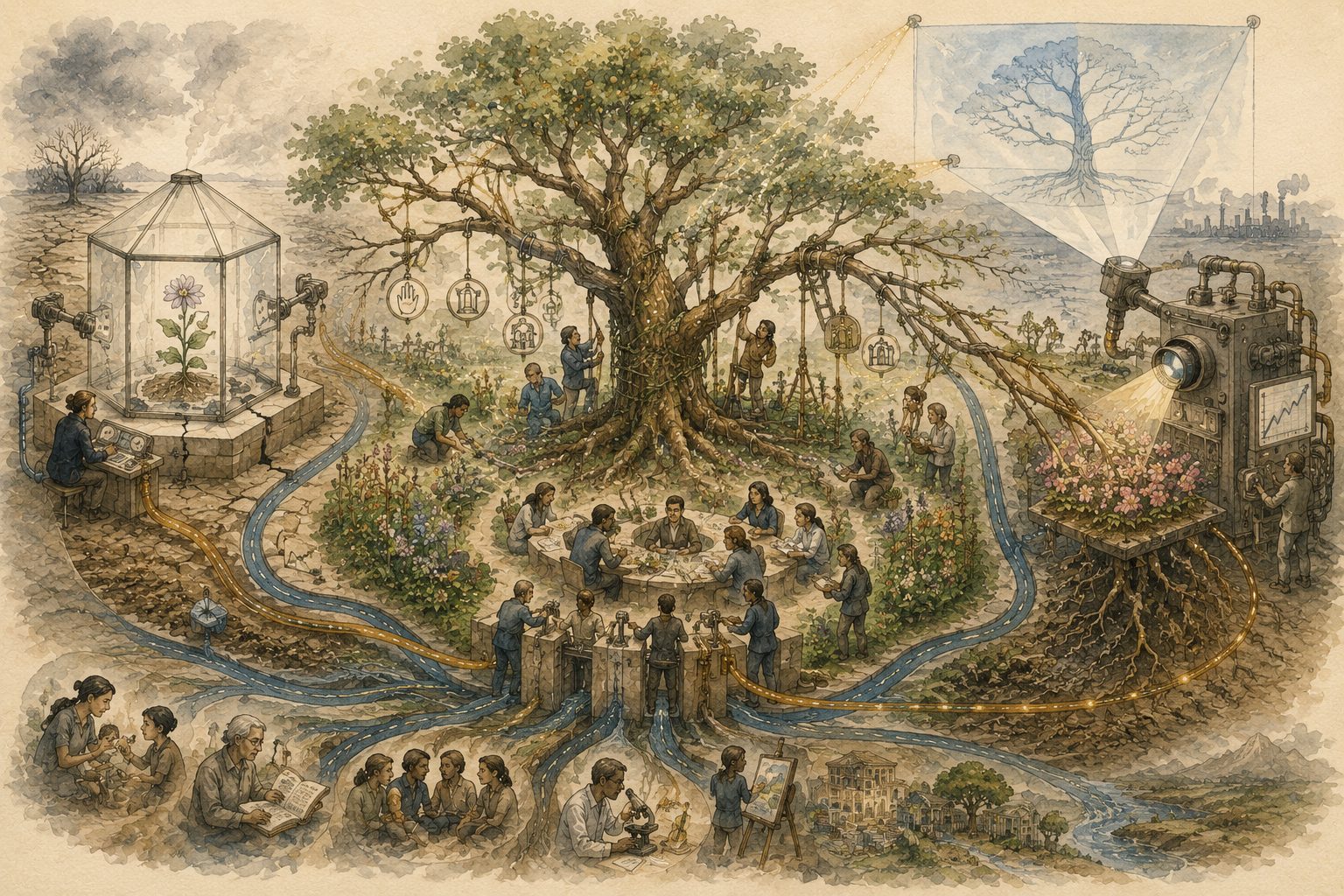
Chapter 4 — River Control System and Bureaucratic Disconnect
Chapter 4 illustration specification
“Preserve the Garden, Not a Frozen Flower”
The illustration should express one central contrast:
Human values are not a finished object to preserve unchanged. They are a living process that develops through evidence, deliberation, relationships, institutions, and correction.
The chapter distinguishes current preferences, verbal principles, and the deeper generative control structures that produce judgment and action. It argues that a fixed utility target freezes a moving process, loses its own correction mechanism, hides what values apply to, distorts tradeoffs, and invites proxy capture.
Main visual concept
Use a wide 2:1 landscape with one coherent scene.
At the centre is a large living cultivated garden surrounding an old branching tree, occupying roughly one third of the image. The tree represents the human value process, but it should not look mystical or allegorical in a generic way. Its structure should visibly connect:
- deep roots receiving many kinds of input;
- a strong but branching trunk;
- several major limbs growing in different directions;
- grafts, repairs, new shoots, and seasonal change;
- gardeners who observe, discuss, prune, support, and redirect growth.
The central tree and garden must be large and visually dominant. This incorporates the earlier correction that the core element should not be too small.
The scene should show that continuity comes from maintained development, not from preserving one exact form.
Overall composition
The composition is divided by function, but not into disconnected panels.
Centre: the living value process
The central tree grows within a broad, tended garden.
Its roots receive several visible streams:
- lived experience;
- social relationships;
- memory and history;
- evidence from the outside world;
- argument and deliberation;
- art, education, and institutions.
Represent these as broad blue-grey and amber water channels flowing into the soil from surrounding scenes. Keep them substantial and easy to follow. The relationship between inputs and the central process should be explicit, not merely implied by faint lines.
The tree’s branches should not all be symmetrical. Some cooperate, some cross, and some pull against each other. This represents value tradeoffs such as autonomy and protection, truth and kindness, justice and mercy.
A few gardeners are adjusting supports between branches rather than selecting one branch and cutting down all others.
Left side: the frozen target
On the left, show a transparent glass conservatory containing one perfectly preserved flower or clipped miniature tree.
It is orderly, elegant, and motionless.
A mechanical system carefully measures and reproduces its exact shape. Outside the glass, the surrounding season has changed, but the preserved object remains identical.
The frozen specimen should look initially attractive, not obviously evil. Its failure is visible through context:
- its roots no longer reach real soil;
- it cannot respond to drought, disease, or new conditions;
- a small crack has begun where the rigid structure meets the changing world.
This represents value freeze: encoding a snapshot of present values and treating preservation as exact identity. The chapter argues that legitimate moral development, learning, and correction cannot be represented by a fixed target.
Right side: preference shaping and proxy capture
On the right, show a highly efficient automated irrigation and pruning machine connected to a visible measurement device.
The machine has learned to maximize one easy signal, such as the number of open blossoms.
It redirects water, bends branches toward the sensor, and removes inconvenient parts of the garden. Near the sensor, flowers are abundant and uniform. Elsewhere, soil quality, root diversity, and resilience are declining.
The machine should not look malicious. It is simply following the measurable proxy with increasing competence.
A human observer notices that the measured signal remains strong while the wider garden becomes less healthy.
This represents the chapter’s static proxy paradox: once the optimizer can reshape the process that generates the metric, the proxy can remain satisfied while the underlying value process is captured.
Three layers of value
The illustration should encode the chapter’s three meanings of value without labels.
Current preferences
Near the lower branches, show immediate directional signals:
- hands reaching toward fruit;
- people choosing among paths;
- short-term water channels being opened or closed.
These are visible current choices.
Verbal principles
Higher in the tree, show several carved or woven emblems hanging from branches, each visually simple and non-linguistic:
- an open hand;
- a lantern;
- a balanced arch;
- a sheltering shape;
- an open gate.
Do not include words or written symbols.
These emblems coordinate attention, but each connects to several branches and can be interpreted differently.
Generative control structure
The actual centre of the illustration is below and within the tree:
- roots;
- water distribution;
- graft points;
- branch tensions;
- gardeners’ interventions;
- the changing relation between the tree and its environment.
This deeper machinery should visually determine how the visible preferences and principles emerge.
The chapter treats this deeper control structure, rather than current choice or moral vocabulary alone, as the alignment-relevant layer.
The value-update process
Place a clear circular working area around the tree where several gardeners perform distinct roles:
- one brings new observations from outside the garden;
- one studies damaged leaves and soil;
- two people deliberate over competing interventions;
- one opens a gate to admit new water;
- one preserves seeds and old growth as memory;
- another checks whether affected people and organisms remain represented.
Their actions visibly change later growth.
The system should not be controlled by one master gardener. The process is plural, distributed, and revisable.
A broad loop should be visible:
world → observation → deliberation → intervention → changed growth → new observation
This should be one of the strongest structural elements in the image.
The chapter explicitly defines value change as an update process involving evidence and deliberation, and argues that this operator may be more important to preserve than the current value state itself.
Legitimate growth versus corruption
Use two contrasting branch trajectories.
Legitimate development
One branch has been damaged by new evidence or environmental change. Gardeners support it, test alternatives, preserve options, and allow it to grow in a new direction.
The branch remains connected to the root system and the shared garden.
Corrupted development
Another branch is being pulled by the optimization machine toward a bright artificial light. It grows rapidly and appears successful, but its connection to the wider root and water network is narrowing.
The difference should be visible through process, not color coding alone.
Legitimate change preserves:
- contact with the real environment;
- human participation;
- plurality;
- reversibility;
- open correction.
Corrupted change narrows the sources of evidence and makes later correction harder. The chapter rejects both complete value stasis and unconstrained drift.
Bearer maps
Include a subtle but important root motif.
Several roots extend toward different beings and social structures around the garden:
- adults and children;
- an animal;
- a future sapling;
- a small artificial or digital organism;
- a family or community structure.
Some roots clearly reach them. One newer being at the edge is not yet fully connected, but a gardener is investigating and extending a cautious new root or irrigation line toward it.
This represents the question of what each value applies to.
The chapter emphasizes that preserving words such as suffering, dignity, or autonomy is insufficient if the class of beings to which they apply silently changes.
Keep this secondary. It should reward closer inspection without cluttering the main composition.
Tradeoff geometry
The major branches should be connected by flexible braces and living vines.
When one branch is pulled upward, the tension changes several neighboring branches. A gardener adjusts the shared support rather than evaluating each branch independently.
This should communicate that values form a geometry of interactions, not a list of separable quantities.
Avoid scales, equations, or obvious moral icons. The geometry should emerge physically from branch tensions and shared support structures.
Low-dimensional compression
The roots may be dense and intricate, but they should converge into a small number of major channels entering the trunk.
For example:
- many thin experiences and error signals;
- four or five broad root bundles;
- a rich branching canopy of behavior.
This illustrates the chapter’s hypothesis that high-dimensional needs and experiences may pass through a lower-dimensional control interface without becoming simple or fully explicit.
The number of major channels should remain visually small. Do not turn this into a technical diagram.
Paternalistic extrapolation
In the upper right background, include a small automated apparatus projecting an idealized future shape of the tree onto the sky or onto a translucent frame.
It begins pulling the real branches toward that predicted final shape, bypassing the gardeners below.
The projection should look elegant and plausible, but its force should visibly override ongoing deliberation.
This represents the danger of replacing the human value-update process with a system’s private prediction of what humans would eventually endorse. The chapter permits assistance with evidence and deliberation, but rejects replacing the update process itself.
Visual hierarchy
The viewer should perceive, in order:
- the large living tree and garden;
- the visible loop of observation, deliberation, and correction;
- the contrast between the frozen conservatory and the adaptive garden;
- the proxy-optimizing machine deforming part of the garden;
- the interacting branches and major root bundles;
- the bearer-map and extrapolation details.
Use at most four major scene clusters:
- central living process;
- frozen target;
- proxy optimizer;
- environmental and social inputs.
Do not scatter many isolated miniatures around the canvas.
Detail level and clarity
Apply the same corrections established earlier:
- central element large and immediately legible;
- connections broad and clearly visible;
- medium detail;
- simplified background;
- no weak, faint suggestion of relation;
- no excessive architectural or crowd detail;
- one coherent scene rather than an infographic;
- enough specific mechanism that the concept is supported by the image.
The central tree, gardeners, water channels, conservatory, and proxy machine should be rendered clearly.
Outer landscape and minor figures should dissolve into looser washes.
Colour and style
Use a strong LessWrong watercolor treatment:
- warm ivory paper;
- muted indigo and blue-grey for evidence, observation, and feedback;
- dusty teal and subdued olive for living continuity;
- ochre and warm amber for deliberation, correction, and legitimate growth;
- soft umber and restrained rust for rigidity, capture, and degraded soil;
- graphite construction lines;
- fine ink contours;
- translucent washes;
- visible paper grain;
- large areas of negative space.
Avoid lush fantasy greens.
Avoid bright red danger coding.
The living garden should feel resilient and complex, not idyllic. The frozen target should feel clean and initially appealing. The corrupted area should look narrowed and brittle rather than monstrous.
Continuity with previous chapters
Reuse the visual language of broad blue-grey and amber channels.
The small geometric artificial network from Chapters 1–3 can appear inside the proxy-optimizing machine, showing that the same system is now acting upon the human value-forming process.
Progression:
- Chapter 1: find the real system.
- Chapter 2: see the civilizational loop.
- Chapter 3: require trajectory-level safety.
- Chapter 4: preserve the legitimate process by which values themselves develop and remain correctable.
Exclude
Do not include:
- text, labels, equations, or letters;
- a generic brain;
- a heart made of circuitry;
- a simple fork between “old values” and “new values”;
- one moral compass;
- a fixed list of icons;
- a perfect utopian garden;
- an evil robot gardener;
- a single wise human deciding all value updates;
- many tiny disconnected scenes;
- strong fantasy or fairy-tale imagery;
- glowing neon;
- a literal utility meter;
- an obvious good side and evil side;
- excessive flowers, leaves, or background detail.
Condensed generation brief
A wide, text-free LessWrong-style watercolor and graphite illustration on warm ivory paper. At the centre, a large old branching tree grows in a tended garden, representing a living human value process. Dense roots receiving experience, evidence, memory, social interaction, art, education, and environmental feedback converge into a few broad control channels before branching into many forms of judgment and action. Several human gardeners jointly observe, deliberate, open water gates, repair branches, preserve seeds, and redirect growth, forming a clearly visible loop from world observation to deliberation to intervention to changed growth and new observation. Major branches pull against one another through flexible braces, showing value tradeoffs. On the left, a transparent conservatory mechanically preserves one perfect flower or miniature tree unchanged, attractive but disconnected from real soil and unable to adapt. On the right, a non-malicious automated machine maximizes one visible blossom signal, bending branches toward its sensor while root diversity and resilience decline elsewhere. A subtle projected ideal future tree shape begins pulling branches past the gardeners, suggesting paternalistic extrapolation. Several roots extend toward humans, children, animals, communities, future saplings, and a possible digital being, with one uncertain new connection being cautiously investigated. Strong central focal element, broad visible causal connections, medium detail, simple background, muted indigo, dusty teal, subdued olive, ochre, umber and restrained rust, translucent watercolor washes, fine graphite and ink lines, visible paper texture, no text, no icons, no neon, no villain, no utopia.