
The Civilization That Steers Itself
Chapter 2 — Circular Interweaving of Society and Technology
Chapter 2 illustration specification
“The Civilization That Steers Itself”
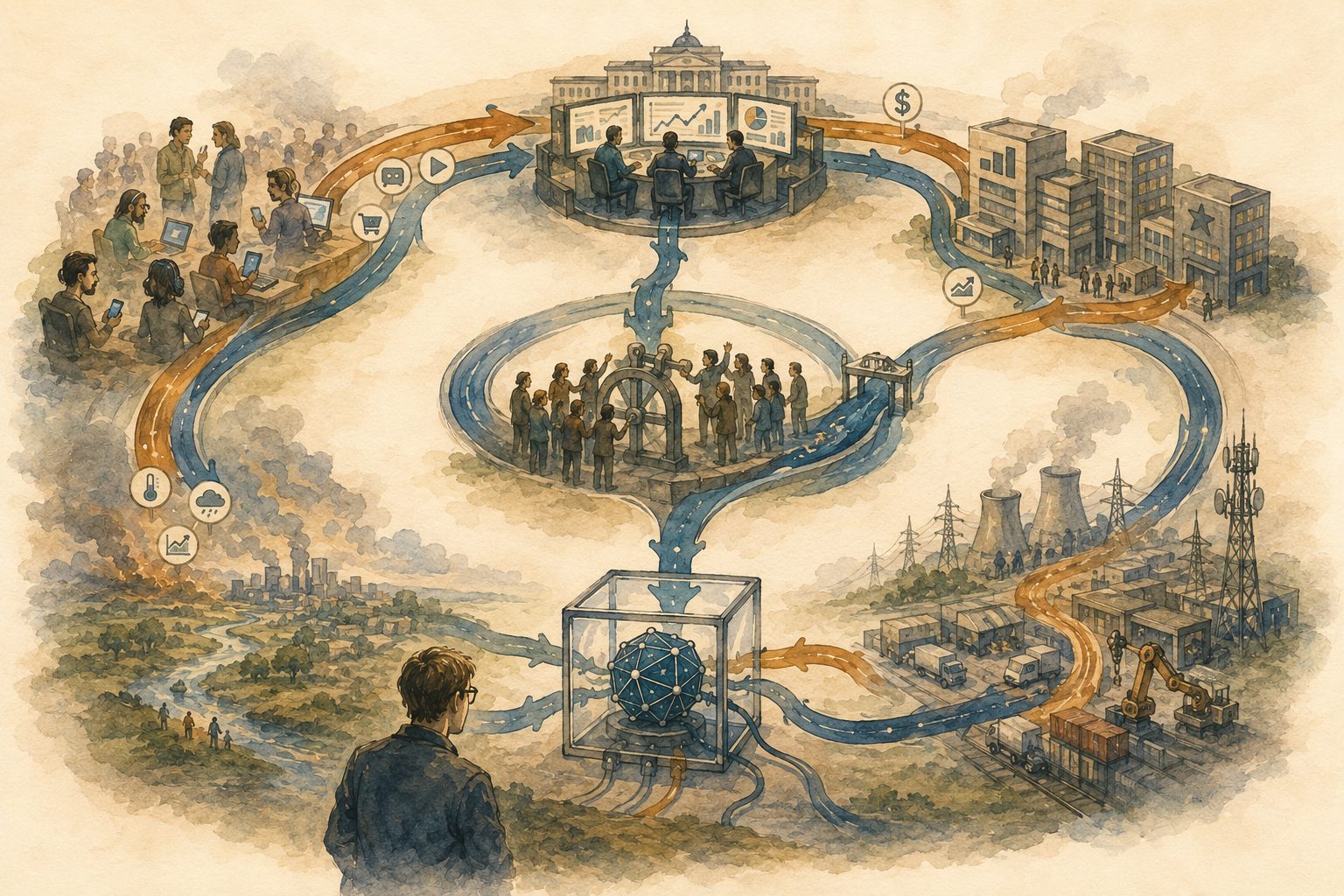
Chapter 2 expands the object from the model-level system of Chapter 1 to an artificial-civilizational control loop: people, models, institutions, infrastructure, incentives, and representations forming a persistent system that senses, decides, acts, and updates itself. The illustration should therefore feel like the camera has pulled back from the glass box and revealed that the surrounding world is itself the larger machine.
Core composition
Use a wide 2:1 landscape, matching the Chapter 1 illustration.
The dominant shape is a single broad circular flow occupying most of the image. It passes through five visually distinct but interconnected regions:
- AI laboratory and compute
- Products and human use
- Markets and organizational decisions
- Government and public institutions
- Physical infrastructure and resource flows
The loop should be immediately legible from a distance. Use broad, continuous bands rather than many thin arrows. The system should look neither like a technical flowchart nor like an ordinary cityscape. It should look like a city whose roads, information channels, and institutions have become parts of one circulatory system.
Main focal element
At the lower centre, place the glass-box model from Chapter 1, now much smaller.
It remains recognizable as a geometric network inside a transparent enclosure, but it is clearly only one component. Several thick channels enter and leave it. These channels merge into the much larger civilizational loop.
This creates the intended progression:
- Chapter 1: the model is not the whole system.
- Chapter 2: even the surrounding product loop is nested inside something civilization-sized.
The glass box should occupy roughly one-sixth of the image, not the centre half.
The civilizational loop
Arrange the larger system as a roughly oval circulation around the model.
Upper left: human use and social interpretation
A small group of people interacting through devices, conversation, work, and shared media. Keep them grouped into one clear scene, not many individual miniatures.
Their actions feed into the loop as aggregated signals rather than direct commands.
Upper centre: institutional compression
A building combining features of a company, administrative office, and control room. Inside, a small number of decision-makers look at simplified dashboards while a much larger stream of human activity is compressed into a few charts, indicators, and priorities.
This visually expresses civilization as compressed coordination.
Upper right: markets and competition
Two or three organizations moving along the same current, each trying to advance faster. Their competition should pull the shared flow forward.
Avoid portraying anyone as malicious. The danger comes from ordinary local incentives creating system-level momentum.
Lower right: physical execution
Energy infrastructure, logistics, automated machinery, communication towers, and supply chains. These convert abstract decisions into changes in the physical world.
The chapter stresses that the loop does not merely exchange information. It acts through infrastructure and changes the environment.
Lower left: world feedback
Show the consequences returning through the environment: changed landscapes, public behaviour, resource availability, and new measurements. These flow back toward users, institutions, and the model.
The result should be a visibly closed cycle:
world → observations → compressed decisions → delegated action → changed world
The chapter explicitly frames the relevant system as an arrangement that senses, compresses, selects actions, changes the world, and updates from the consequences.
Human correction channel
Place a public forum or civic plaza near the inside edge of the loop.
A diverse group is attempting to redirect the system through a movable gate, switch, or steering lever. Their channel connects to the main flow, but it is visibly narrower than the channels carrying deployment, capital, infrastructure, and automated feedback.
The correction channel should still work. It should not look broken. But the image should raise the question:
Can human correction still exert enough leverage once the wider loop has momentum?
A secondary bypass should curve around the civic control point, suggesting that parts of the system can continue even when correction is delayed.
Self-stabilizing pattern
The overall loop should subtly resemble a large living circulatory organism, but only through composition:
- the institutional centre resembles a heart,
- channels resemble arteries,
- infrastructure resembles limbs,
- users and sensors resemble sensory organs.
Do not draw an actual giant creature. The effect should emerge after a second look.
This supports the chapter’s claim that artificial civilization may exhibit civilizational agency without being a person or possessing a single mind. The self-stabilizing pattern matters more than personhood. The chapter includes bureaucracy, markets, scientific communities, and AI labs as possible control loops of this kind.
Delegation shift
Include one visual transition from human execution to machine execution.
For example, near the laboratory:
- a human hand initially operates a small control,
- farther along the same channel, automated systems operate many larger controls,
- the human becomes an observer of aggregated outcomes.
Keep this subtle. It represents superintelligence as a change in the amount and depth of delegation, rather than merely a larger brain or smarter robot. The chapter’s sections explicitly move from the scale shift through delegation, tool failure conditions, self-stabilization, correction, and power.
Visual hierarchy
The viewer should notice, in order:
- the large circular civilizational flow;
- the small glass-box model embedded within it;
- the major institutional and material components;
- the narrow human correction channel;
- the fact that no individual controls the whole system.
Use five or six major scenes at most. Each scene should be simplified into a strong silhouette or cluster. Avoid the over-detailed distant crowds of the first Chapter 1 attempt.
Colour and rendering
Use the established LessWrong-watercolour treatment:
- warm ivory paper;
- desaturated blue-grey ink outlines;
- muted slate blue, dusty teal, pale ochre, soft umber, and restrained rust;
- thin graphite construction lines;
- translucent washes with visible paper texture;
- selective warm amber highlights for information and control flow;
- large areas of unpainted paper;
- soft edges away from the central loop.
The loop itself should be slightly stronger in saturation than the surrounding scenes, but not rendered as bright infographic arrows. It should resemble a flowing band of water, light, roads, and information at once.
Continuity with Chapter 1
Reuse three motifs:
- the same glass-box model;
- the same small human researcher or evaluator, now standing outside the larger loop and seeing only part of it;
- the same blue and amber channels.
But reverse the hierarchy. In Chapter 1, the model and its immediate connections dominate. In Chapter 2, the model becomes a small organ inside a civilizational-scale process.
Exclude
Do not include:
- written labels;
- national flags or recognizable political parties;
- a central evil corporation;
- a giant humanoid AI;
- robot armies;
- a glowing brain over a city;
- cyberpunk neon;
- a neat collection of independent icons;
- dozens of arrows;
- a single control room that obviously governs everything;
- apocalyptic destruction.
The risk should arise from distributed, locally reasonable decisions that combine into a powerful persistent trajectory, not from villainy. This matches the chapter’s focus on alignment failures without villains, self-stabilizing patterns, and correction at civilizational scale.
Condensed generation brief
A wide, text-free LessWrong-style watercolor and ink illustration on warm ivory paper. A large, clearly visible circular civilizational flow connects an AI laboratory, human users, institutional decision-making, market competition, public governance, physical infrastructure, and environmental feedback. At the lower centre, the geometric AI model from the previous illustration sits inside a small transparent glass box, clearly only one component of the much larger system. Broad blue-grey and muted amber currents connect all regions into one persistent feedback loop. A public civic forum operates a narrow steering gate connected to the main current, while part of the flow subtly bypasses it. No villain and no central controller. The entire composition faintly resembles a living circulatory organism without literally becoming a creature. Medium detail, strong visual hierarchy, few major scenes, spacious negative areas, muted indigo, dusty teal, ochre, umber, restrained rust, graphite lines, translucent watercolor washes, no text.