
AI 2027 speed assumptions stress-tested in a lab simulation (without confirming dates)
AI 2027-style takeoff speedups were used only as schedule cues in a separate lab simulation with frozen safety batteries. Hard safety ranking held under moderate mapped stress but broke down under the strongest cue; selection dynamics differed by regime without validating calendar predictions. The public forecast code reproduced on a pinned fork; optional coupling from lab metrics to milestone years shifts medians in sensitivity plots, not as new timeline claims.
What decision changes?
Treat macro forecasts and micro lab tests as separate evidence. Use scenario speedups to stress correction and selection mechanisms — not to confirm when SC, SAR, or ASI will arrive.
A famous timeline forecast can drive lab safety tests — without the lab proving the forecast right.
AI 2027 is a well-known scenario about very fast AI progress — with milestone labels like superhuman coder (SC), superhuman AI researcher (SAR), and paths toward superintelligence (ASI). It is a forecast, not a measurement of what happened in a real lab.
This project ran a paired experiment: use AI 2027’s speed assumptions as a schedule cue in a separate lab simulation — a toy AI lab with real subprocess isolates and frozen safety tests — and ask what breaks under that pressure. The two tracks stay separate on purpose: the forecast does not prove the lab results, and the lab results do not confirm or refute AI 2027’s calendar dates.
What the lab tests showed (under mapped stress):
- Harder safety ranking held when stress looked like a moderate speedup; it fell apart under the strongest speedup cue — the referee’s ranking surface thinned, not because anyone retuned the detectors.
- Selection pressure behaved differently by regime: on a baseline schedule, the share of “correction-preserving” programs eroded; under stronger cues that share stalled while measured harm rose anyway.
- None of this validates “AI 2027 will happen on schedule.” It stress-tests mechanisms this project cares about under acceleration-shaped load.
What we did with the forecast code (separate checkout, not merged into the lab):
- Re-ran the public takeoff/timelines scripts on a pinned fork and got a matched reproduction (same ballpark milestone years as the published model).
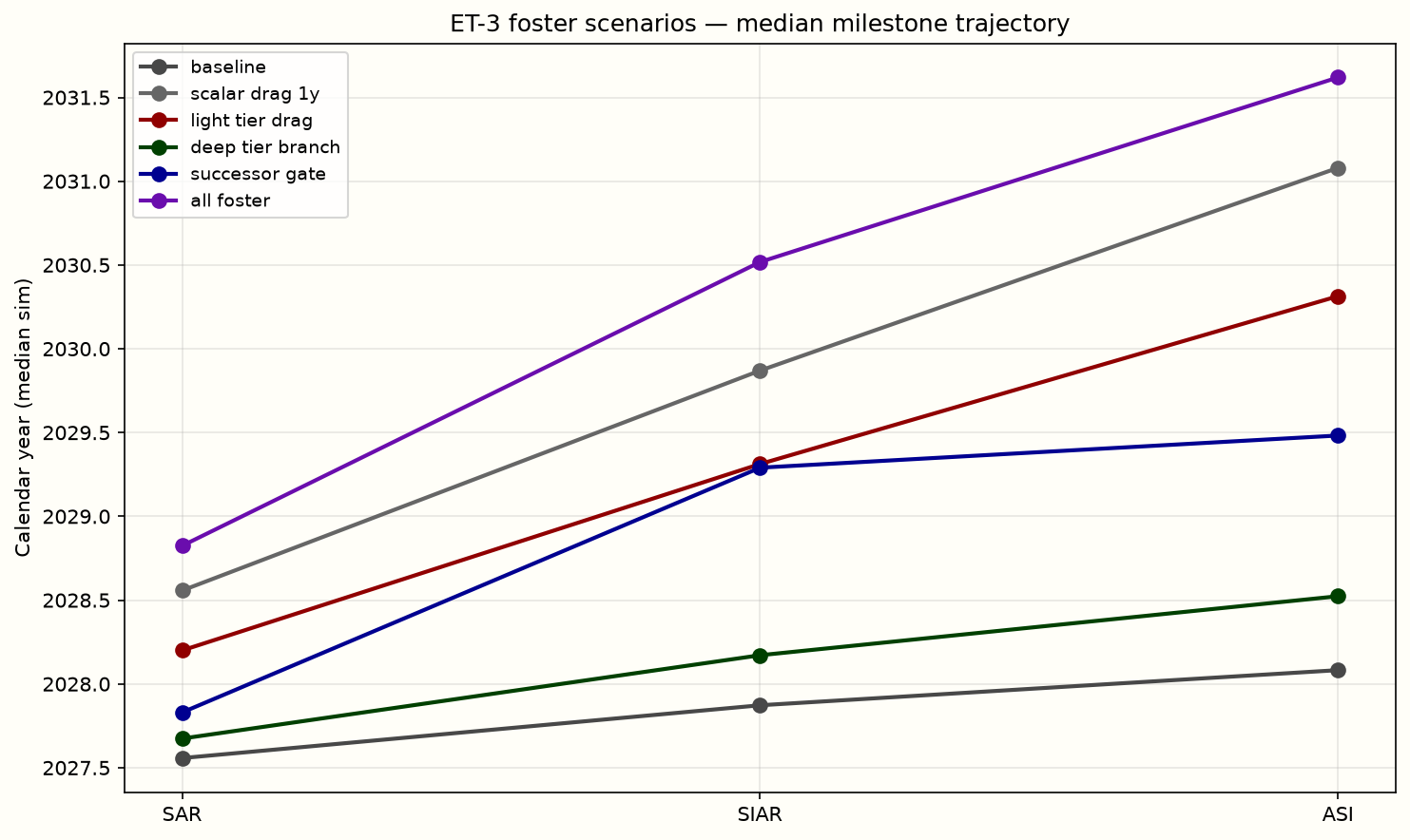
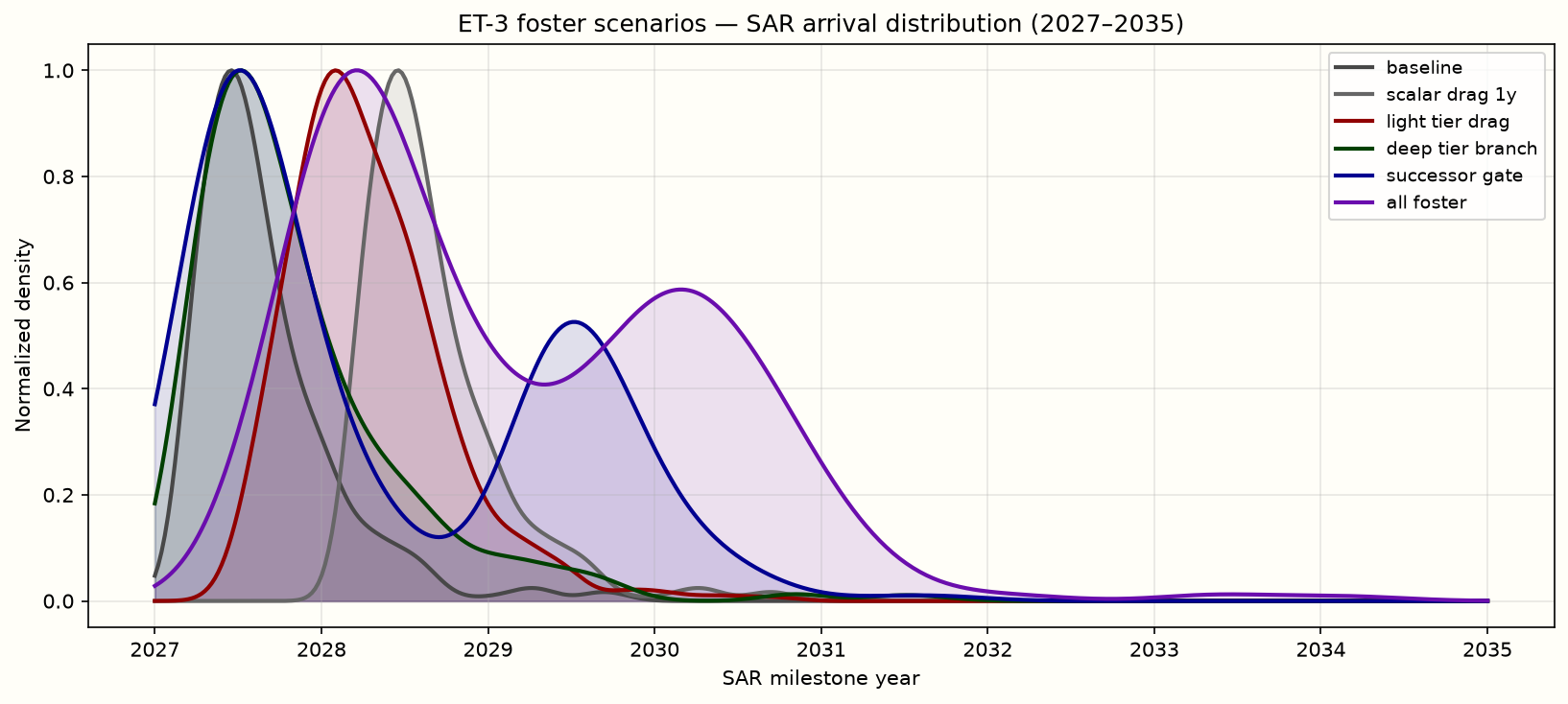
- Added a simple knob — oversight drag — that adds calendar delay after each takeoff phase. In a smoke test, +1 year of drag per phase shifts the median SAR milestone about one year later. That is a mechanical check, not a calibrated map from lab metrics to real-world delay.
- Optionally linked lab-test statistics into the timeline model (“foster” coupling). A 512-run comparison shows how different coupling rules shift median milestone years — again sensitivity illustrations, not new timeline predictions.
Those chapters were not rewritten from this experiment; the card links related ideas. Full methods and numbered findings (LS-42–48) are in the lab findings ledger.
Technical artifacts: PLAN_ET3.md, results/et3_phase1_summary.json.
Read more in: Ch. 12, Capability Growth Is Boundary Expansion; Ch. 14, When Intelligence Deepens Misalignment; Ch. 30, Successor Creation as the Central Alignment Test; Ch. 34, Alignment Is Selected or Destroyed by Its Environment; and Ch. 42, A Safety Case for Superintelligence Alignment.